
Contributing to insulation design for high-voltage EVs
with high tracking-resistance engineering plastics
Enabling Both Electrical Insulation and Dimensional Stability with High-CTI Material
Conventional challenges
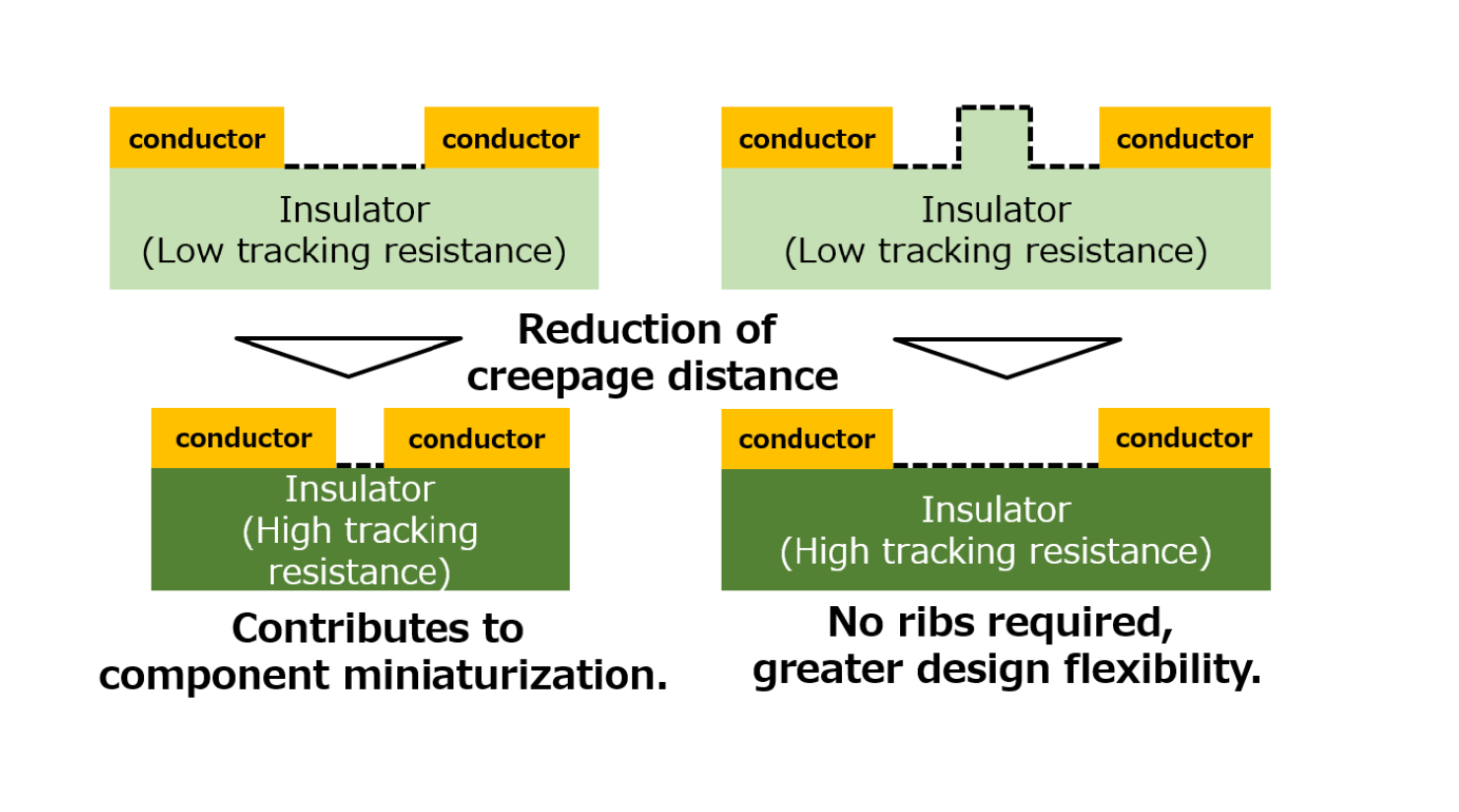
As drive voltages increase, EV components such as batteries and motors require higher insulation performance than ever before. In particular, to suppress tracking on the surface of insulating components, design constraints have increased—such as extending the distance between conductive parts and adding ribs.
*Tracking: When voltage is applied to an insulating material whose surface is contaminated by moisture, dust, etc., micro-discharges cause decomposition that forms a carbonized.
Solution
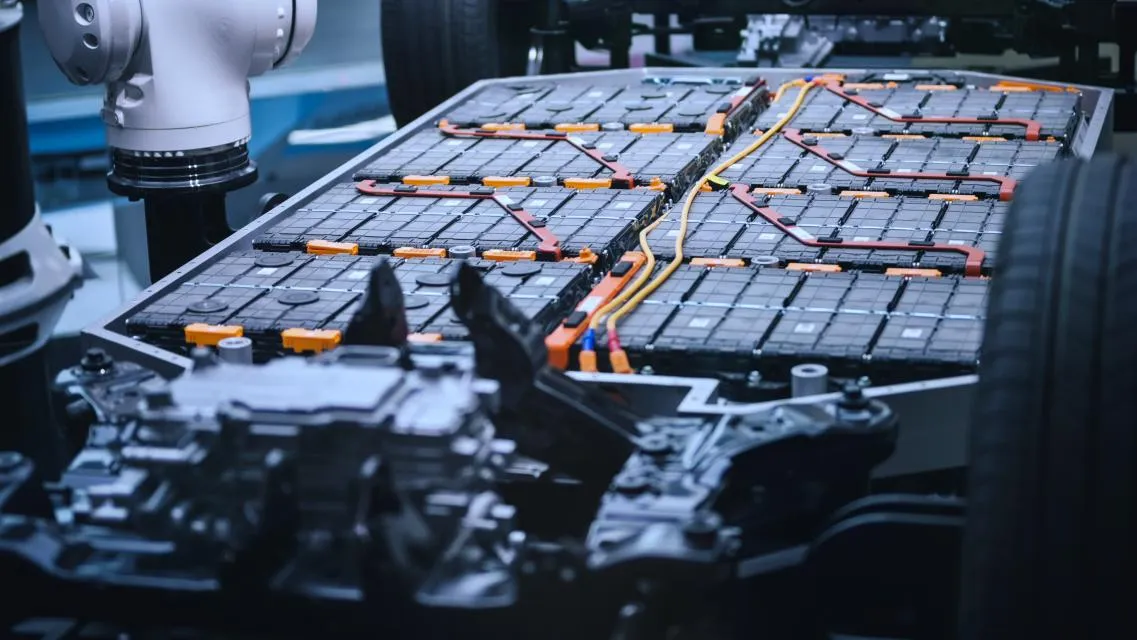
By adopting Iupiace™ HCT20V, an m-PPE resin with the highest tracking-resistance class (Comparative Tracking Index (CTI): 600 V; UL PLC 0), we contribute to improved safety of battery enclosures.
◇Key features of Iupiace™ HCT20V
- High tracking resistance: CTI 600 V (UL PLC 0)
- Flame retardancy: 1.5 mm, V-1 (UL 94)
- Excellent insulating properties suitable for high-voltage applications (high dielectric withstand)
- Dimensional stability due to low water absorption (suppresses dimensional changes under temperature/humidity)
Expected benefits after adoption
- Improved tracking resistance enables shorter distances between conductors, contributing to smaller components and greater design flexibility
- Improved durability of battery enclosures by providing chemical resistance to electrolytes assumed in Li-ion battery applications
- Low water absorption and excellent dimensional stability make it easier for fit/seal designs to remain viable, even in humid environments
- Contributes to weight reduction through metal replacement
Download Materials
Supporting High-Voltage Connector Miniaturization and Retention Performance with Thin-Wall, Flame-Retardant, High-Stiffness Material
Conventional challenges
High-voltage EV connectors are trending toward miniaturization and higher density, and thin-wall designs around 0.4 mm are required. However, smaller and thinner designs make the following issues more prominent:
- Insufficient electrical safety margin: With higher voltages (800 V class), securing creepage distance and clearance becomes more stringent, raising concerns about surface leakage and tracking under contamination/condensation conditions
- Flame retardancy (V-0): The thinner the wall, the higher the hurdle for flame retardancy, reducing material selection flexibility
- Warpage and dimensional variation: Warpage of the housing can disrupt mating performance and terminal positional accuracy, making it difficult to secure the intended distances (creepage/clearance)
- Compatibility with assembly processes (reflow): High heat resistance is required; material selection must consider thermal deformation and property degradation
- Property changes due to moisture absorption: General polyamide resins have high water absorption, raising concerns about changes in strength, rigidity, and dimensions
Solution
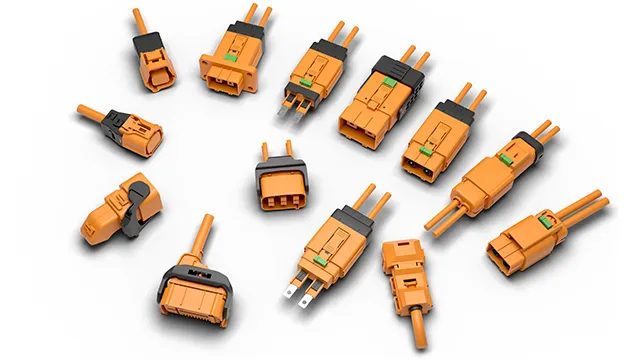
By applying our high-performance polyamide resin RENY™ 1524SL to HV connectors, we help improve key thin-wall/miniaturization challenges: tracking resistance, flame retardancy, low warpage, heat resistance, and properties after moisture absorption.
In particular, we support 800 V-class high-voltage designs from both perspectives: shape stability due to low warpage and countermeasures against surface leakage/tracking enabled by high CTI (800 V or higher).
◇Key features of RENY™ 1524SL
- Tracking resistance: CTI equivalent to 800 V (PLC 0 equivalent)
- Flame retardancy: V-0 equivalent at 0.4 mm
- High heat resistance contributes to compatibility with connector mounting reflow processes
- Small property degradation after moisture absorption, maintaining performance under humid conditions
- Low warpage contributes to stable mating performance and terminal positional accuracy
- High rigidity suppresses deformation in thin-wall sections and stabilizes latching/locking functions
| Properties | Test method | Test condition | Units | RENY™1524SL | Competitor PA FR grade |
|---|---|---|---|---|---|
| Density | ISO 1183 | - | g/cm³ | 1.69 | 1.68 |
|
Flexural stress Flexural modulus |
ISO 178 | 23℃ | MPa MPa |
336 (301) 19,900 (19,900) |
330 (240) 18,500 (15,500) |
|
Charpy notched impact strength |
ISO179-1, 179-2 |
23℃ | kJ/m² | 16 (16) | 9 |
|
Deflection temperature under load |
ISO 75-1, 75-2 |
1.80MPa | ℃ | 249 (240) | 227 |
| Flammability | UL94 | - | - | 0.4mmt/V-0 equivalent | 0.4mmt/V-0 |
| Tracking resistance | IEC 60112 | - | - | PLC0 equivalent (CTI800V equivalent) |
PLC0 |
Expected benefits after adoption
- Improved tracking resistance enables shorter distances between conductors, contributing to smaller components and greater design flexibility
- Supports connector miniaturization and higher density while maintaining V-0 flame retardancy
- Improved reflow resistance enables component design that accounts for the assembly process, contributing to greater design flexibility
- Small property variation after moisture absorption contributes to stable mating and retention performance across diverse use environments
- Reduced warpage is expected to lower mating defects and terminal misalignment, contributing to improved assemblability and quality stability